How to Repair a Damaged Skin Barrier Naturally
Understanding the science behind comfortable, hydrated, resilient skin—and how to support its natural recovery.
Softness. Radiance. Comfort. These are the qualities we admire in healthy skin—but they all begin with something we rarely see.
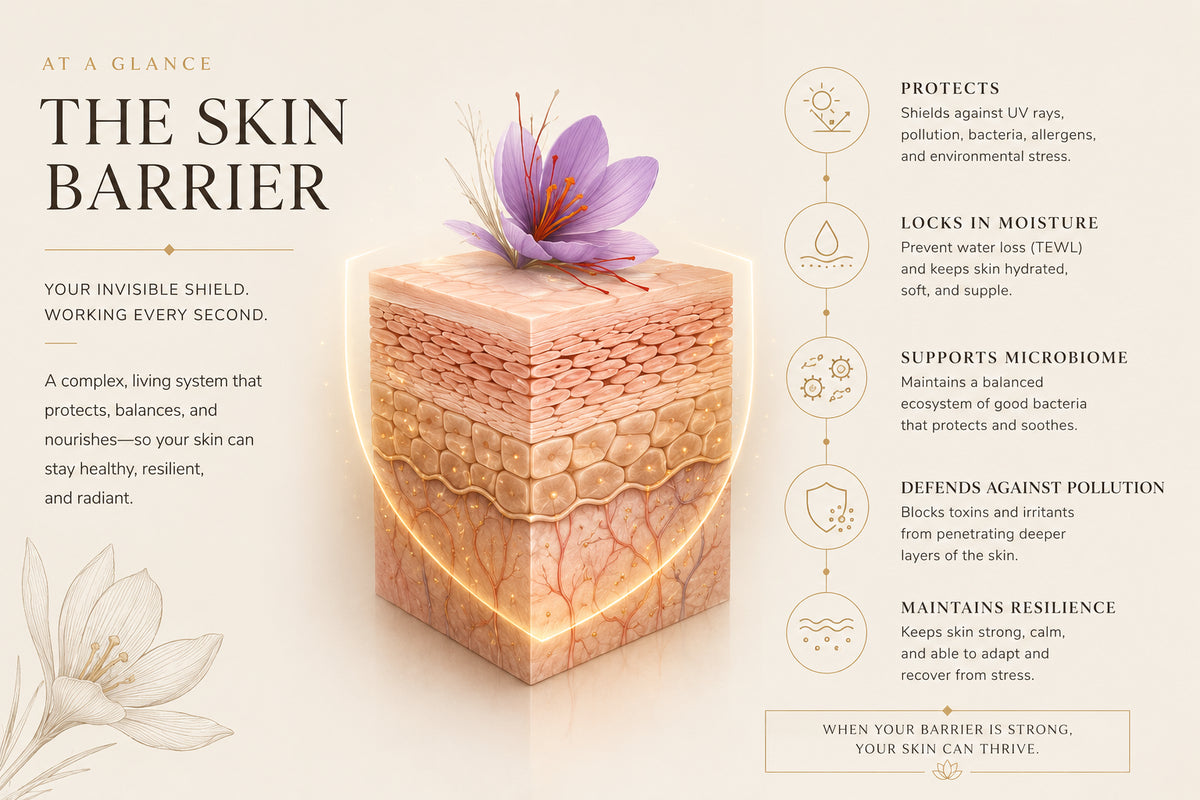
Beneath every glowing complexion lies an invisible protective system working around the clock to keep skin balanced, hydrated, and resilient. Known as the skin barrier, this remarkably thin outer layer locks moisture in, keeps environmental aggressors out, supports a healthy microbiome, and creates the conditions skin needs to renew itself.
Most of us do not notice the skin barrier until it begins to struggle.
Perhaps your cleanser suddenly leaves your face feeling tight. A moisturizer you have trusted for years no longer relieves dryness. Products that once felt soothing now sting, and your skin becomes unexpectedly reactive.
These changes often lead people to believe they have developed “sensitive skin.” In reality, they are frequently signs that the skin’s natural protective barrier has been compromised.
Modern life places that barrier under constant pressure. Frequent cleansing, over-exfoliation, ultraviolet exposure, pollution, dry indoor environments, and chronic stress can gradually weaken its ability to protect itself. As that defense becomes disrupted, moisture escapes more easily while irritants penetrate more readily—appearing as dryness, redness, irritation, and heightened sensitivity.
The encouraging news is that skin is designed to recover. With gentle care, thoughtful ingredients, and consistent daily habits, the barrier can gradually restore its strength.

Understanding the Skin Barrier
The skin barrier is one of the smallest structures in the human body—and one of its most important.
Known scientifically as the stratum corneum, it forms the outermost layer of the epidermis. Although only a fraction of a millimeter thick, it regulates water loss, shields the skin from environmental irritants, supports a balanced microbiome, and maintains the stable environment needed for healthy renewal.
When this protective layer functions well, skin simply feels comfortable. Cleansing does not leave it tight. Moisturizer performs as expected. Active ingredients are well tolerated, and the complexion appears balanced and resilient.
Science Snapshot
The stratum corneum is extraordinarily thin, yet it serves as the body’s first line of defense. Its condition influences hydration, comfort, reactivity, and the skin’s ability to tolerate everyday environmental stress.
The “Brick and Mortar” Architecture
Dermatologists often describe the skin barrier using a simple analogy: a brick wall. The “bricks” are flattened skin cells called corneocytes. The “mortar” is a carefully balanced mixture of ceramides, cholesterol, and free fatty acids—the lipid matrix that seals the spaces between them.
Together, these components create a flexible barrier that keeps moisture inside while helping prevent pollutants, allergens, and microorganisms from moving deeper into the skin.

When the lipid matrix becomes disrupted, microscopic gaps begin to form. Water escapes more readily through transepidermal water loss (TEWL), while external irritants find it easier to penetrate.
Long before these changes become visible, skin often begins communicating that something is wrong: tightness after cleansing, persistent dryness, or sensitivity to products that once felt comfortable.
Is Your Skin Barrier Trying to Tell You Something?
Healthy skin rarely demands your attention. When the barrier is functioning well, your routine feels effortless. Barrier disruption, by contrast, often begins with small signals that are easy to dismiss on their own but meaningful when they appear together.
Your face may feel tight within minutes of cleansing. A moisturizer may suddenly seem less effective. A familiar serum may begin to sting. Your complexion can become dry, rough, red, or unpredictable without an obvious cause.
These changes do not necessarily mean your skin has permanently become sensitive. They often mean its protective barrier has been weakened.
Common Signs
- Tightness immediately after cleansing
- Persistent dryness or flaking
- Redness, itching, or visible irritation
- Stinging when applying familiar products
- Difficulty tolerating active ingredients
- Increased sensitivity to weather changes
- Skin that feels oily on the surface but dehydrated underneath
- Breakouts accompanied by irritation
No single symptom confirms barrier damage on its own. But when several appear together—especially after adding new products or increasing exfoliation—it is often a sign that skin needs less correction and more support.
What Weakens the Skin Barrier?
Healthy skin is remarkably resilient. Every day, it adapts to changes in temperature, humidity, ultraviolet radiation, pollution, and countless other stressors while continuously renewing itself.
Barrier damage rarely happens because of one mistake. More often, it is the accumulated effect of small, well-intentioned habits repeated before the skin has enough time to recover.
Cleansing Too Aggressively
Harsh surfactants, frequent washing, very hot water, or vigorous scrubbing can remove the natural lipids that hold the barrier together. Effective cleansing should leave skin refreshed—not squeaky clean.
Over-Exfoliation
Acids, retinoids, and resurfacing treatments can be valuable, but layering them or using them too often pushes cell shedding faster than the barrier can rebuild.
Environmental Exposure
UV radiation, pollution, low humidity, wind, and climate-controlled indoor air can increase oxidative stress and accelerate water loss.
Too Many Products
Introducing several new treatments at once forces the skin to adapt repeatedly and makes it difficult to identify what is actually helping—or causing irritation.
Lifestyle Stress
Poor sleep, chronic stress, smoking, inadequate nutrition, dehydration, and prolonged sun exposure can all slow the skin’s natural recovery processes.
Not Enough Recovery Time
Even beneficial treatments become disruptive when the skin is never given a quiet interval to replenish lipids, regulate inflammation, and restore comfort.
The challenge arises when the demands placed on skin consistently exceed its ability to recover. Fortunately, the opposite is also true: reducing unnecessary stress creates space for repair.
Can a Damaged Skin Barrier Recover?
The answer is reassuring: yes.
The outermost layers of skin are in constant renewal. New cells form, old ones shed, and the lipid matrix is gradually replenished. Your skin already knows how to heal. The role of skincare is not to force that process—it is to create the conditions that allow it to happen.

Simplify Before You Add
When skin becomes irritated, the instinct is often to buy another serum, a richer moisturizer, or a stronger treatment. A compromised barrier, however, tolerates active ingredients and frequent routine changes less effectively.
Return temporarily to the essentials: a gentle cleanser, a well-formulated moisturizer, and daily broad-spectrum sunscreen.
Cleanse Without Compromising
Cleansing should remove sunscreen, excess oil, sweat, and environmental buildup while preserving the lipids that keep the barrier intact. Consider the formula, frequency, water temperature, and technique—not merely whether the face feels “clean.”
For a deeper look at this principle, read Why Sensitive Skin Needs a Gentler Cleanser.
Restore Hydration and Barrier Lipids
Humectants such as glycerin and hyaluronic acid attract water into the outer layers of the skin. Ceramides, cholesterol, free fatty acids, squalane, and compatible botanical oils help reinforce the structure that keeps that water from escaping.
Think of hydration as filling a reservoir. Barrier lipids repair the walls that hold the water inside. Both matter.
Pause Potent Actives
Retinoids, exfoliating acids, and resurfacing treatments have an important place in skincare—but not necessarily during active barrier recovery. Once tightness, stinging, and visible irritation have settled, reintroduce them gradually, one at a time.
Protect What You Are Rebuilding
Daily sunscreen, moderate water temperature, adequate sleep, gradual product changes, and patience help prevent additional stress while the barrier restores itself.
Science Snapshot
Barrier recovery is often felt before it is seen. Products stop stinging, post-cleansing tightness fades, and skin feels comfortable through the day before texture and radiance visibly catch up.
Ingredients That Support Barrier Recovery
Healthy barrier function does not depend on one “miracle” ingredient. It relies on complementary ingredients working together—some attract water, some reinforce the lipid matrix, and others help calm visible irritation or defend against oxidative stress.

Build the Barrier
Ceramides form a major part of the skin’s natural lipid matrix and help reduce water loss. Squalane is a lightweight, skin-compatible lipid that softens without heaviness. Niacinamide supports resilience and can encourage the skin’s own ceramide production.
Restore Hydration
Glycerin remains one of the most effective and well-studied humectants, drawing water into the outer layers of the skin. Hyaluronic acid binds water and can ease dehydration when paired with ingredients that help seal moisture in.
Calm and Protect
Panthenol supports hydration and recovery. Colloidal oatmeal is widely used for dry, irritated skin because it helps soothe discomfort while supporting barrier integrity. Botanical antioxidants—including Centella asiatica, green tea, turmeric, licorice root, and saffron—may help reduce the oxidative stress that places additional pressure on compromised skin.
Saffron’s naturally occurring compounds, including crocin, crocetin, and safranal, have demonstrated antioxidant and anti-inflammatory activity in laboratory and preclinical research. Their role in skincare is explored further in The Science of Saffron.
| Skin Goal | Supportive Ingredients |
|---|---|
| Restore hydration | Glycerin, hyaluronic acid |
| Reinforce barrier lipids | Ceramides, squalane, compatible botanical oils |
| Support resilience | Niacinamide, panthenol |
| Calm visible irritation | Colloidal oatmeal, panthenol, Centella asiatica |
| Provide antioxidant support | Saffron, green tea, turmeric, licorice root |
How Long Does Skin Barrier Repair Take?
There is no single recovery timeline. It depends on the degree of disruption, age, overall skin health, environment, and how consistently the skin is supported.
Mild disruption may begin to feel better within one to two weeks after switching to a gentler routine. More noticeable compromise often requires several weeks. Prolonged irritation or repeated over-exfoliation may take considerably longer.
Recovery is not always linear. Weather, stress, hormones, and environmental exposure can temporarily affect how the barrier feels. A difficult day does not necessarily mean progress has stopped.
The most useful markers are often sensory: less tightness, reduced stinging, greater comfort after cleansing, and improved tolerance of a simple routine.
Ancient Wisdom Meets Modern Skin Science
Long before modern dermatology described ceramides, lipid matrices, or transepidermal water loss, Ayurveda approached skin through a broader idea: preserve balance, avoid unnecessary disruption, and support the body’s capacity to renew itself.
Ayurvedic Perspective
- Gentle, ritual-based cleansing
- Nourishing plant oils and botanicals
- Balance rather than aggressive correction
- Attention to sleep, stress, hydration, and nourishment
- Consistency and patience
Modern Dermatology
- Barrier-compatible cleansing
- Lipid and humectant replenishment
- Reduced exposure to irritants
- UV protection and environmental defense
- Evidence-based routine consistency
These perspectives use different language, but they often lead toward the same practical principle: skin becomes more resilient when its natural protective systems are respected.

The Maska Philosophy
Healthy skin is not something to fight into submission. It is something to understand.
At Maska Organics, every formulation begins with a simple question: Will this respect the skin barrier?
That means prioritizing gentle cleansing, balanced hydration, compatible botanical lipids, and antioxidant-rich ingredients—without overwhelming compromised skin with aggressive correction.
When the barrier feels supported, skin is better able to restore its own balance. Sometimes the most effective skincare is not about doing more. It is about knowing when to do less.
Conclusion
Softness, radiance, and an even-looking complexion all begin with something less visible: a healthy barrier.
When that barrier is compromised, dryness, redness, tightness, and reactivity are not merely cosmetic inconveniences. They are signs that the skin’s first line of defense is working harder than it should.
The good news is that skin is designed to recover. Gentle cleansing, thoughtful hydration, lipid support, daily sun protection, and patience create the conditions it needs to rebuild resilience.
The enduring lesson is simple: healthy skin is rarely built by doing more. More often, it reflects the quiet consistency of doing the right things, day after day.
Key Takeaways
- The skin barrier retains moisture while helping defend against environmental irritants.
- Persistent dryness, stinging, redness, or post-cleansing tightness may indicate barrier disruption.
- Over-cleansing, over-exfoliation, UV exposure, environmental stress, and excessive product layering can weaken barrier function.
- Recovery begins by simplifying the routine and reducing unnecessary irritation.
- Humectants replenish water; ceramides, squalane, and other lipids help keep it from escaping.
- Consistency—not intensity—is the foundation of long-term skin resilience.
Frequently Asked Questions
What is the skin barrier?
The skin barrier refers primarily to the stratum corneum, the outermost layer of the epidermis. It helps retain moisture and protects against environmental irritants, allergens, pollutants, microorganisms, and excessive water loss.
What are the signs of a damaged skin barrier?
Common signs include persistent dryness, tightness after cleansing, redness, stinging with product use, flaking, rough texture, increased sensitivity, and oily-yet-dehydrated skin. Several occurring together are more meaningful than one symptom alone.
Can a damaged skin barrier repair itself?
Yes. Skin renews continuously and can restore barrier function when supported by a gentle routine, adequate hydration, compatible lipids, sun protection, and reduced exposure to irritants.
How long does repair take?
Mild disruption may improve within one to two weeks, while more significant compromise can require several weeks or longer. Improvement is often felt before it becomes visible.
Which ingredients support barrier recovery?
Ceramides, glycerin, hyaluronic acid, niacinamide, squalane, panthenol, colloidal oatmeal, compatible botanical oils, and antioxidant-rich botanicals can all play supportive roles.
Should I stop exfoliating acids and retinoids?
Temporarily reducing or pausing potent actives often allows recovery to happen more efficiently. They can usually be reintroduced gradually once the skin feels comfortable again.
Can oily skin have a damaged barrier?
Yes. Oily skin can still be dehydrated or barrier-impaired, especially after over-cleansing or over-exfoliation. Removing too much surface oil may even encourage compensatory oiliness.
When should I see a dermatologist?
Seek professional guidance for persistent burning, swelling, severe itching, cracking, oozing, widespread rash, suspected infection, or symptoms that do not improve with a simplified routine.
Research Evidence Summary
| Topic | Level of Evidence |
|---|---|
| Skin barrier structure and function | Strong |
| Ceramides and barrier-lipid support | Strong |
| Humectants and skin hydration | Strong |
| Niacinamide, panthenol, and colloidal oatmeal | Moderate to strong |
| Antioxidant botanical support | Emerging to moderate |
Scientific Review & Accuracy
This article has been internally reviewed against dermatological, cosmetic-science, and botanical research available at the time of publication. It is intended for education and is not a substitute for medical diagnosis or treatment.
Last reviewed: July 2026
Scientific References
- Elias PM. Stratum Corneum Defensive Functions: An Integrated View. Journal of Investigative Dermatology. 2005.
- Madison KC. Barrier Function of the Skin: “La Raison d’Être” of the Epidermis. Journal of Investigative Dermatology. 2003.
- Proksch E, Brandner JM, Jensen JM. The Skin: An Indispensable Barrier. Experimental Dermatology. 2008.
- Elias PM. Skin Barrier Function. Current Allergy and Asthma Reports. 2008.
- Rawlings AV, Harding CR. Moisturization and Skin Barrier Function. Dermatologic Therapy. 2004.
- Voegeli R. The Effect of Cleansing on the Skin Barrier. Clinics in Dermatology. 2012.
- Del Rosso JQ. The Role of Skin Barrier Repair in the Management of Dermatoses. Journal of Clinical and Aesthetic Dermatology. 2011.
- Draelos ZD. The Science Behind Skin Care: Moisturizers. Journal of Cosmetic Dermatology. 2018.
- Chamlin SL, et al. Ceramide-Dominant Barrier Repair Lipids Improve Childhood Atopic Dermatitis. Journal of the American Academy of Dermatology. 2002.
- Papakonstantinou E, Roth M, Karakiulakis G. Hyaluronic Acid: A Key Molecule in Skin Aging. Dermato-Endocrinology. 2012.
- Gehring W. Nicotinamide: Mechanisms of Action and Its Topical Use in Dermatology. Journal of Cosmetic Dermatology. 2004.
- Ebner F, Heller A, Rippke F, Tausch I. Topical Use of Dexpanthenol in Skin Disorders. American Journal of Clinical Dermatology. 2002.
- Fowler JF Jr. Colloidal Oatmeal Formulations in Dermatology. Journal of Drugs in Dermatology. 2014.
- Assimopoulou AN, Sinakos Z, Papageorgiou VP. Radical Scavenging Activity of Crocin, Crocetin and Safranal from Saffron. Phytotherapy Research. 2005.
- American Academy of Dermatology Association. Dry Skin: Self-care Recommendations.
- British Association of Dermatologists. Dry Skin Patient Information.
- World Health Organization. Ultraviolet Radiation and Skin Health.
Disclaimer
This article is intended for educational and informational purposes only and should not be considered medical advice. Individual skin responses vary. Consult a qualified dermatologist or healthcare professional regarding persistent irritation, suspected skin disease, or specific medical concerns.