Natural vs. Synthetic Skincare: Why Ingredient Origin Alone Never Determines Quality
Beyond the Label: How Nature and Science Come Together in Thoughtful Skincare
Natural vs. synthetic skincare, explained. Discover why ingredient origin alone never determines quality - and how botanicals and lab-developed ingredients work together in truly effective formulations.
Where the Story Begins
The story of skincare doesn't begin in a laboratory. It begins in nature.
Long before a botanical extract reaches a bottle, a flower has already spent months responding to sunlight, rainfall, and the countless challenges of its environment - producing remarkable chemistry not for us, but for its own survival.[3] Scientists later study that chemistry. Formulators learn how to preserve it. Somewhere along the way, we simply call it skincare.
Consumers today read ingredient lists more closely than ever, and words like natural, botanical, clean, and science-backed have become everyday vocabulary. That's a welcome shift toward transparency - but it has also introduced quiet confusion, because most of these words carry no universal regulatory definition. In the United States, the FDA has not established a formal definition for "natural" in cosmetic labeling.[10] A "natural" label doesn't guarantee gentleness, and a "science-backed" one doesn't guarantee superior results.
Natural refers to ingredients from naturally occurring sources - plants, minerals, marine organisms. Botanical is narrower, describing ingredients drawn specifically from plant flowers, leaves, roots, seeds, fruits, or extracts. Aloe vera, chamomile, green tea, rosehip, turmeric, saffron - each has evolved sophisticated chemical defenses to survive sun, drought, and pests without ever moving an inch.
Yet origin alone tells an incomplete story. Botanical origin doesn't guarantee suitability for every complexion, and plant extracts and essential oils may cause irritation or allergic contact dermatitis in susceptible individuals.[9] A botanical's journey doesn't end at harvest - in many ways, that's where it begins.
Key Takeaway: Nature provides extraordinary raw materials. Turning them into effective skincare requires careful extraction, thoughtful craftsmanship, and preservation of delicate botanical chemistry.
Creating botanical skincare is agriculture, chemistry, and quality control working in sequence - harvesting, drying, extraction, filtration, standardization, and stability testing. This is why two products listing the same botanical can perform in entirely different ways. The difference rarely lies in what was used. It lies in how that ingredient's journey was managed.
Synthetic often sounds artificial, but in cosmetic science it carries a simpler meaning: an ingredient created or modified through carefully controlled processes - sometimes entirely new, sometimes inspired by natural molecules but engineered for greater consistency, purity, or stability. These ingredients keep oil and water blended, soften texture, extend shelf life, and protect a formula from microbial contamination. Without them, even the most beautiful botanical formulation would separate or spoil long before the bottle was empty.
Seen this way, botanicals and laboratory-developed ingredients are not opposites. They are collaborators, each contributing something the other cannot - nature's richness alongside science's precision.
Side by Side: Botanical and Laboratory-Developed Ingredients
| Aspect | Botanical Ingredients | Laboratory-Developed Ingredients |
|---|---|---|
| Origin | Derived from plants, flowers, roots, seeds, fruits, or other naturally occurring sources. | Created or refined through carefully controlled scientific processes. |
| Purpose in Skincare | Contribute naturally occurring compounds studied for their cosmetic properties. | Improve stability, consistency, texture, preservation, and overall performance. |
| Chemical Nature | Naturally complex mixtures containing many different compounds. | Often designed to perform specific functions within a formulation. |
| Consistency | May vary with growing conditions, harvest timing, and extraction method. | Produced with high consistency from batch to batch. |
| Formulation Considerations | Require careful sourcing, extraction, and preservation to maintain quality. | Require thoughtful formulation to ensure compatibility, safety, and effectiveness. |
| Common Examples | Aloe vera, saffron, chamomile, green tea, rosehip, jojoba. | Humectants, emulsifiers, stabilizers, preservatives, peptides. |
| Greatest Strength | Rich botanical diversity developed through millions of years of evolution. | Precision, consistency, and support for sophisticated modern formulations. |
| Considerations | Natural variation, sensitivity in some individuals, stability challenges if mishandled. | Often misunderstood - "synthetic" gets confused with "unsafe" despite serving important functional roles. |
Nature's First Laboratory
Plants can't move, hide, or run - so they survive through chemistry. Every leaf and root is a quiet chemical factory, producing compounds that absorb ultraviolet radiation, neutralize environmental stress, discourage pests, and repair damage.[1] Modern skincare simply studies this chemistry, asking which of it might also benefit human skin.

Every plant carries its own chemical signature, shaped by species, climate, soil, sunlight, and harvest timing - which is why sourcing and quality control matter so much. Researchers continue to study compounds such as polyphenols, carotenoids, flavonoids, fatty acids, and polysaccharides for their potential roles in topical skincare.[2],[3] A single botanical often contains hundreds of these compounds, forming what scientists call a phytocomplex - a naturally balanced chemical system rather than a collection of isolated actives. Saffron, for instance, isn't simply crocin and crocetin; it's a fuller mixture of carotenoids, flavonoids, amino acids, and more.
Key Takeaway: A botanical extract is far more than one "active ingredient" - it's a naturally balanced chemical system shaped by evolution, environment, and processing.
The path from plant to product runs through cultivation, harvesting, sorting, extraction, filtration, standardization, testing, formulation, and stability assessment. A remarkable plant alone doesn't create remarkable skincare - every stage after harvest matters just as much.

Extraction is the bridge between nature and craftsmanship. Temperature, oxygen exposure, pH, storage, and the delivery system can substantially influence the stability of delicate plant-derived compounds.[8] Skilled extraction preserves a botanical's complexity; careless processing quietly erodes it - which is why identical ingredients, handled differently, can perform in entirely different ways.
The Craftsmanship of Formulation
A great ingredient doesn't guarantee a great product. Think of a symphony: a beautiful performance isn't created by one exceptional musician, but by dozens performing in harmony. Skincare composition works the same way - botanical extracts, humectants, emollients, emulsifiers, preservatives, and pH adjusters all working together, none of them carrying the finished result alone.
Formulators ask different questions than consumers do. Rather than does this contain saffron, a cosmetic chemist is more likely to ask whether the extract will remain stable over time, whether the pH suits the whole composition, and whether the chosen ingredients will stay compatible after months on a shelf. These considerations are invisible to the person applying the product, yet they quietly determine whether it stays safe and enjoyable from first use to last.

Ingredients must remain compatible with one another. The pH must support the stability of the entire formula. Preservation systems protect the product throughout its intended life, particularly in a humid bathroom where contamination finds every opportunity. Texture matters more than most people realize - a composition that feels pleasant and absorbs comfortably is simply more likely to become part of a daily habit. And packaging is rarely just branding: airless pumps, opaque containers, and protective seals shield delicate formulas from light, air, and contamination.
"The true luxury of skincare is not found in rare ingredients. It is found in the care with which every ingredient is understood, preserved, and brought together."
This is why two moisturizers can share the same headline botanicals - aloe, green tea, saffron - and still feel entirely different in use. One absorbs effortlessly; the other feels heavy. One stays smooth for months; the other separates. The difference comes from concentration, extraction quality, emulsification, and manufacturing craftsmanship - much as two chefs, given identical ingredients, can produce two very different meals.
Bold takeaway: Nature and laboratory science were never meant to compete. They are collaborators. Traditions like Ayurveda, which has incorporated saffron, turmeric, sandalwood, and neem into skincare for thousands of years, offer historical insight built through generations of observation. Modern research adds analytical understanding to that same botanical wisdom.
The Purpose of Every Formulation
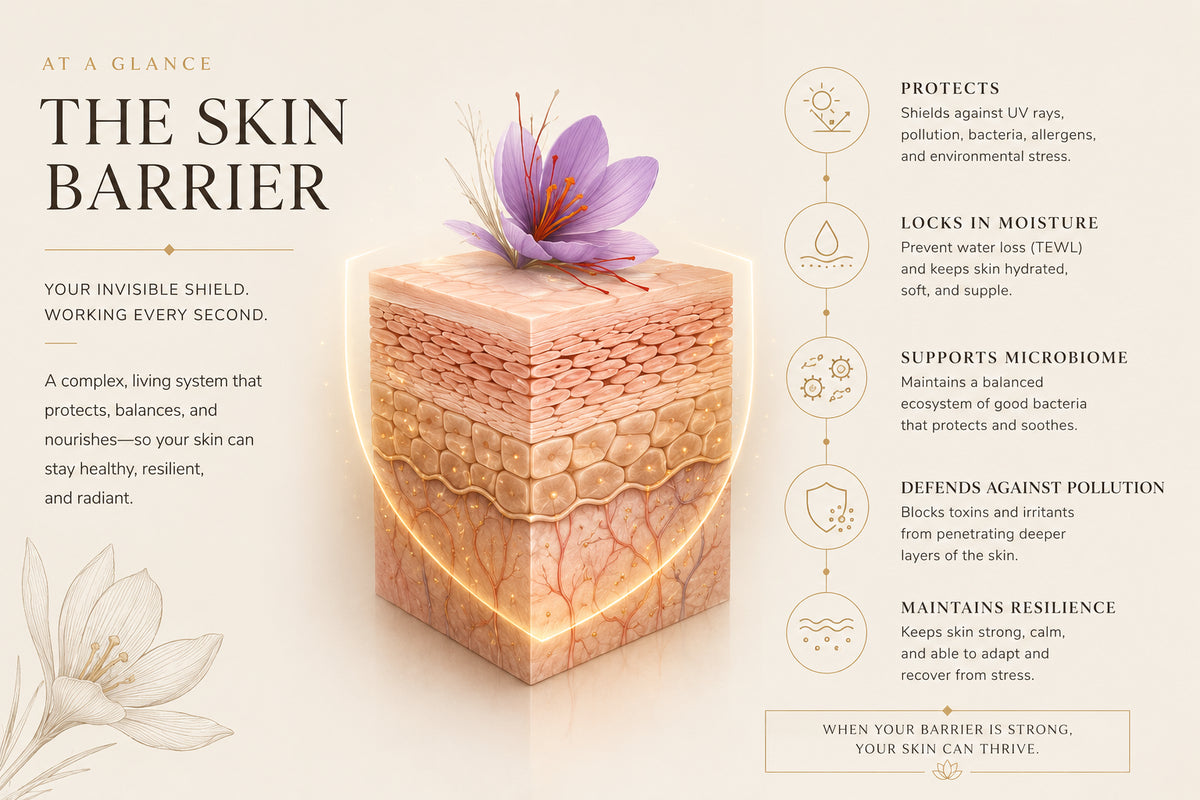
All of this exists for one reason: to help skin do the job it was designed to do. Beautiful skin is skin that functions well - regulating moisture, protecting against environmental stress, supporting its own microbiome, and forming an extraordinary barrier between your body and the outside world.
The skin's outer layer, the stratum corneum, relies on an organized lipid matrix of ceramides, cholesterol, and free fatty acids to limit water loss and reduce the penetration of outside substances.[5],[6] This living structure continuously renews itself, adjusting and repairing in response to temperature, humidity, cleansing, and UV exposure. Skincare's role was never to override that intelligence - it exists to support it.

See these principles in a finished formulation: explore the Maska Icons collection - each product built on the same balance of botanical wisdom and formulation science described in this article.
Skin Science Insight: Healthy skin is not the result of one extraordinary ingredient. It is the result of a healthy barrier supported by consistent care, formulation expertise, and everyday habits.
Stronger isn't always better. An overly aggressive cleanser can strip more than makeup and oil - it can disturb the skin's natural barrier[7] - and too many active ingredients layered together may overwhelm the complexion rather than support it. Thoughtful craftsmanship begins by asking not what is the strongest formulation we can create, but what does healthy skin actually need. Often the answer is quieter than expected: support hydration, maintain the barrier, respect natural balance, and build compositions people genuinely enjoy using, day after day.
Perhaps the most overlooked ingredient in skincare isn't on any ingredient list at all. It's consistency. A beautifully developed formulation offers little value sitting unused on a shelf. Products that feel pleasant to apply and layer well encourage habit - and habit is where thoughtful formulation design finally gets to do its work.
Understanding this journey changes the questions worth asking. Rather than chasing whatever ingredient is trending, it's worth wondering whether a brand explains its approach to formulation rather than leaning only on marketing language, whether its botanicals were chosen with clear purpose, and whether it's something you could realistically use with any consistency at all.
Looking Beyond the Label
The next time you pick up a skincare product, look past the words natural or synthetic on the label. Somewhere, a flower has spent months responding to changing seasons. Somewhere else, researchers have worked to understand that chemistry. Formulators have preserved it, balanced it, and thoughtfully incorporated it into a composition designed for everyday life. By the time a bottle reaches your hands, it represents far more than ingredients - it reflects curiosity, research, and craftsmanship.
Because the story of skincare has never been about choosing between nature and science. It has always been about bringing the best of both together.
Maska Organics Formulation Perspective
At Maska Organics, every formulation begins with a simple question: does this ingredient earn its place - not because it's trending, but because it serves the skin? Whether the source is a Kashmiri saffron thread or a carefully chosen stabilizer, the goal is the same: a composition that respects both botanical wisdom and formulation science, built for daily ritual rather than a single dramatic claim.
Frequently Asked Questions
Is natural skincare better than synthetic skincare?
Not automatically. Ingredient origin is only one part of a product's story. Botanical materials contribute complex plant compounds, while laboratory-developed components improve stability, texture, preservation, and consistency. Quality depends on how thoughtfully every element has been combined.
Does natural skincare mean chemical-free?
No. Everything in nature is made of chemicals, including water, plant oils, and the compounds produced by flowers and leaves. "Natural" refers to origin, not the absence of chemistry.
Are synthetic skincare ingredients harmful?
Not inherently. Many laboratory-developed ingredients perform important functions like maintaining texture and supporting preservation. Safety depends on the specific substance, its concentration, and the quality of the finished formula.
Are botanical ingredients always safe for sensitive skin?
No. Plant extracts and fragrant essential oils may irritate some individuals or trigger allergic contact dermatitis.[9] Those with reactive skin should introduce new products gradually and consider patch testing.
What is the difference between natural and botanical skincare?
Natural skincare may include materials from plants, minerals, marine organisms, or other naturally occurring sources. Botanical skincare refers specifically to plant-derived materials - flowers, roots, leaves, seeds, oils, or extracts.
What does "clean skincare" mean?
"Clean" is primarily a marketing term rather than a standardized scientific category. Definitions vary by brand, so it's worth looking past the claim to the full ingredient list and formulation quality.
Why do botanical ingredients need laboratory processing?
Plant materials typically require cleaning, drying, extraction, filtration, purification, and stability testing before they're suitable for cosmetic use - steps that isolate desired compounds and protect delicate chemistry.
Why can two products containing the same botanical perform differently?
The botanical may be present at different concentrations or extracted differently, and the formulas may differ in pH, compatibility, emulsification, and packaging. An ingredient list shows what's present, not how it was built.
What matters most when choosing skincare?
Look for a product suited to your skin type and concerns, and consider the complete formula rather than one headline ingredient. Texture, preservation, packaging, and consistent use all shape a product's real value.
Can natural and synthetic ingredients be used together?
Yes - many sophisticated formulas combine botanical extracts and oils with lab-developed humectants, emulsifiers, stabilizers, preservatives, and peptides. These approaches are complementary, not mutually exclusive.
Is organic skincare the same as natural skincare?
No. "Organic" relates to how qualifying agricultural ingredients are grown and certified. "Natural" carries no formal FDA definition in U.S. cosmetic labeling,[10] and organic claims must still meet applicable safety and labeling requirements.
Should I patch test botanical skincare?
Yes, particularly for sensitive skin or a history of reactions. Apply a small amount as directed and watch for irritation - though a home patch test can't rule out every allergy, and persistent reactions should be evaluated by a dermatologist.
Scientific References
- Reuter J, Merfort I, Schempp CM. Botanicals in dermatology: an evidence-based review. American Journal of Clinical Dermatology. 2010;11(4):247-267. PubMed: PMID 20509719
- Fernandes A, Rodrigues PM, Pintado M, Tavaria FK. A systematic review of natural products for skin applications: targeting inflammation, wound healing, and photo-aging. Phytomedicine. 2023;115:154824. PubMed: PMID 37119762
- Michalak M. Plant-derived antioxidants: significance in skin health and the ageing process. International Journal of Molecular Sciences. 2022;23(2):585. PubMed: PMID 35054770
- Michalak M. Plant extracts as skin care and therapeutic agents. International Journal of Molecular Sciences. 2023;24(20):15444. PubMed: PMID 37895122
- Bouwstra JA, Nădăban A, Gooris GS, et al. The skin barrier: an extraordinary interface with an exceptional lipid organization. Progress in Lipid Research. 2023;92:101252. PubMed: PMID 37666282
- van Smeden J, Bouwstra JA. Stratum corneum lipids: their role for the skin barrier function in healthy subjects and atopic dermatitis patients. Current Problems in Dermatology. 2016;49:8-26. PubMed: PMID 26844894
- Ananthapadmanabhan KP, Mukherjee S, Chandar P. Stratum corneum fatty acids: their critical role in preserving barrier integrity during cleansing. International Journal of Cosmetic Science. 2013;35(4):337-345. DOI: 10.1111/ics.12042
- Krupkova O, Ferguson SJ, Wuertz-Kozak K. Stability of epigallocatechin gallate and its activity in liquid formulations and delivery systems. Journal of Nutritional Biochemistry. 2016;37:1-12. PubMed: PMID 27770867
- Jack AR, Norris PL, Storrs FJ. Allergic contact dermatitis to plant extracts in cosmetics. Seminars in Cutaneous Medicine and Surgery. 2013;32(3):140-146. DOI: 10.12788/j.sder.0019
- U.S. Food and Drug Administration. Small Businesses & Homemade Cosmetics: Fact Sheet. FDA.gov. Accessed 2026. (No regulatory definition exists for "natural" in cosmetic labeling; the same safety and truthful-labeling requirements apply regardless of ingredient source.) FDA.gov
A 2025 systematic review and meta-analysis found encouraging results for some topical botanical preparations in areas such as hydration, melanin measurements, erythema, and elasticity, while also finding insufficient evidence for other outcomes - supporting this article's positive but measured tone on botanical efficacy.
This article draws on peer-reviewed research in dermatology, cosmetic science, and Ayurvedic formulation literature. All referenced studies are linked to their original sources. Every educational article published by Maska Organics is reviewed against current peer-reviewed cosmetic science literature before publication. Claims about ingredient benefits reflect published research and are framed in accordance with cosmetic claim guidelines. Individual results from skincare products vary.
Disclaimer
This article is intended for educational and informational purposes only and should not be considered medical advice. Individual skin responses vary. Consult a qualified dermatologist or healthcare professional regarding specific skin concerns or medical conditions.
Last reviewed: July 2026