Can saffron serum be used around the eyes?
By Suresh Venkat, Co-Founder, Maska Organics · Last reviewed 21 October 2026
Only if the label says so. Use a saffron serum around your eyes only when the finished product's directions explicitly allow it. If the label doesn't mention the eye area, keep the serum away from your eyelids, lash lines and eyes. Saffron on the ingredient list doesn't tell you whether the whole formula belongs there. This 2026 guide shows you how to read those directions, and how to keep a nourishing facial ritual separate from eye care.
- Can saffron serum be used around the eyes? Only when the exact product's directions explicitly permit it. Maska Organics' Celestial Saffron Elixir is made for facial skin only and should not be applied over the eyes.
- Saffron alone doesn't establish eye-area suitability. The complete formula and its instructions decide.
- A facial serum and a natural face cleanser each need their own directions, and neither automatically belongs on the eyelids.
- Celestial Saffron Elixir is formulated for facial skin only, so it should not be applied over the eyes. Keep it on the face, and read its current directions for amount and layering.
- If a serum stings or irritates near the eyes, stop using it there.
Why the skin around your eyes asks for a lighter hand
The skin around your eyes deserves care, and gentleness begins with choosing the right product, not just using less of the wrong one. An ingredient tied to a nourishing facial ritual can't tell you where every finished formula belongs.
Ayurveda is a traditional Indian system of care, and it inspires many botanical skincare rituals. That heritage can give a routine real meaning without replacing a product's own instructions. "Natural" describes where an ingredient comes from. It isn't permission to apply it near your eyes.
Can saffron serum be used around the eyes?
Only if that particular serum explicitly permits eye-area application. A face serum label isn't an eye-treatment label, and permission for one formula doesn't carry over to another that shares the same featured ingredient.
When you review a serum in 2026, let the finished product's directions be the deciding evidence, not a familiar botanical name or a recommendation for a different product.
| Option | Best for | What it offers | Limitation | Your next move |
|---|---|---|---|---|
| Saffron face serum with explicit eye-area directions | Those whose formula permits that use | Product-specific placement instructions | Permission still has boundaries, and it never means putting serum in the eyes | Follow the exact placement and warning language |
| Saffron face serum without eye-area directions | Facial care within its stated instructions | Keeps the serum in its intended facial routine | No basis for extending use to the eyelids or lash lines | Keep it away from the eye area, or ask the brand |
| Product made for the eye area | Those seeking a dedicated eye step | Directions written for that location | Eye-area positioning doesn't guarantee freedom from irritation | Read the warnings and use only as instructed |
Facial use and eye-area use are different things. A silky texture or a comfortable first application doesn't settle it. A serum can feel lovely on your cheeks and still carry directions to avoid the eyes. And a promise of radiance, softness or hydration isn't an instruction to treat under-eye concerns.
How to check whether your serum belongs near your eyes
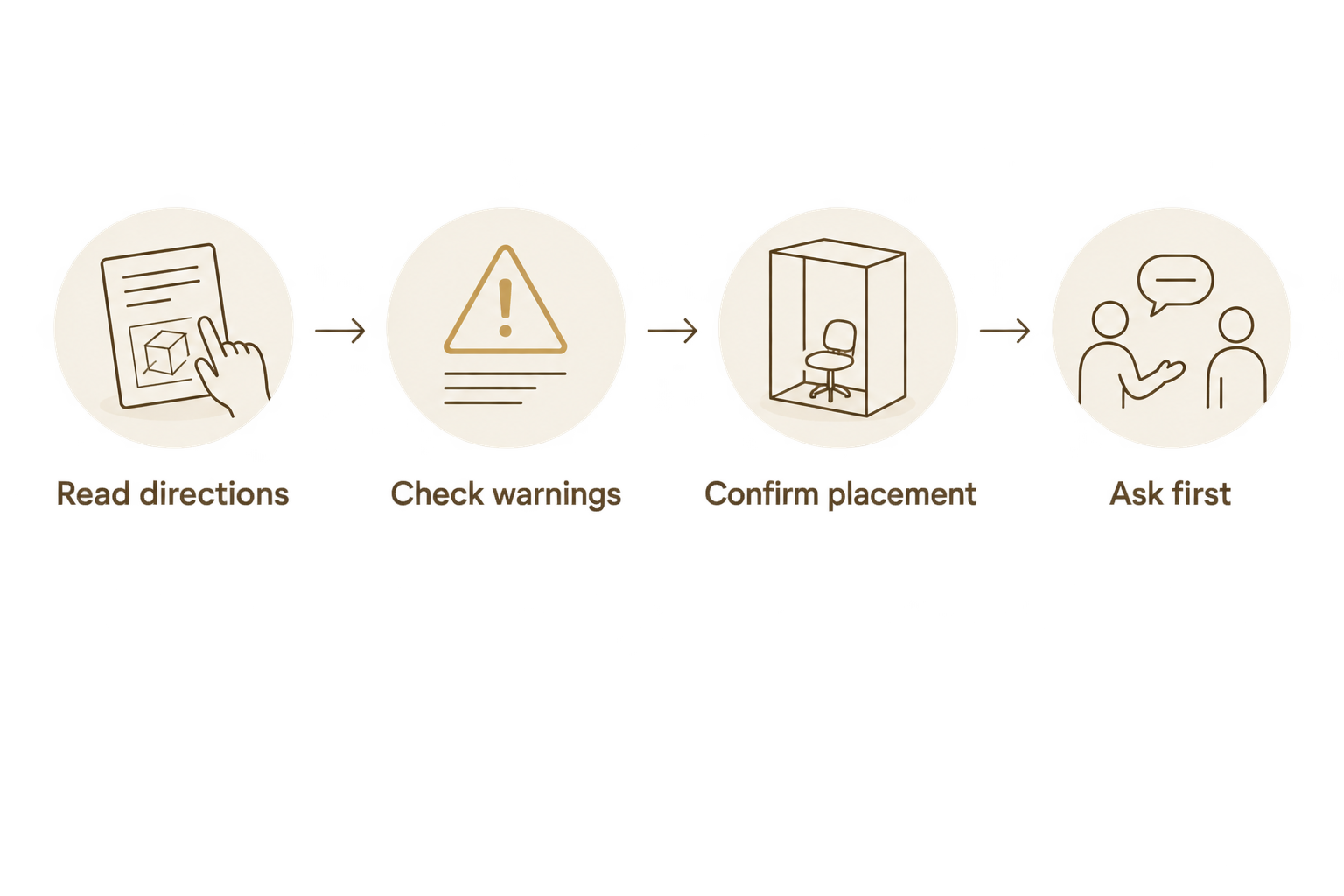
Start with the bottle, the carton and the current official directions for the exact product you own. Similar names, editions or packaging don't mean identical instructions.
- Read the directions. Look for explicit permission to use the formula around the eyes, including any boundaries. "Apply to face" doesn't answer the eye-area question.
- Check the warnings. An instruction to avoid the eye area rules out intentional application there. "Avoid contact with eyes" calls for care too. It isn't an invitation to apply along the lashes.
- Confirm the placement. If eye-area use is allowed, follow the stated location, and don't extend it to the movable eyelid, the inner corners or the lash line.
- Ask first. If the directions leave it open, contact the brand before applying. Ask about the exact formula, not whether saffron in general is suitable.
A useful question to keep in mind: does this exact serum permit use beneath the eyes, and does that permission exclude the eyelids and lash lines? If you can't find a clear answer, don't improvise. Leave the serum out of the eye area, and keep using it elsewhere as directed.
Why eye-area suitability varies
Saffron is one part of a finished formula, not a description of all of it. That's why a single yes-or-no answer for every saffron serum would mislead you.
- The complete ingredient list. A formula holds far more than its headline botanical. Read the whole list, especially for ingredients you already know you react to.
- The intended application area. Face directions don't automatically include the eyelids, under-eye area or lash lines. Follow the location the maker specifies.
- The product's warnings. A warning outranks an appealing ingredient story, and using less doesn't work around it.
- Your skin history. Past reactions to cosmetics matter. If you have an eye condition or an ongoing treatment, ask your clinician before experimenting nearby.
- How you apply it. Working a product near the eye makes accidental contact through rubbing or transfer more likely, so precision matters even when eye-area use is permitted.
Judge botanical skincare the way you'd judge any cosmetic: intended use first, ingredient story second. That doesn't diminish the pleasure of plant-inspired care. It simply gives that care a sensible boundary.
Is saffron serum suitable for eyelids and lash lines?
No, not unless the directions specifically permit those locations. Permission to use a product beneath the eyes doesn't necessarily include the movable eyelid or the edge of the lashes.
"Around the eyes" is looser than it sounds. Read the maker's wording literally, and ask for clarification instead of treating every nearby surface as interchangeable. A video shows one person's technique. It doesn't show that your formula permits the same placement.
Can a patch test prove saffron serum is safe around the eyes?
No. A patch test can help you notice a skin reaction on a small area, but it doesn't test accidental eye exposure, and it doesn't override the label.
Don't patch-test a product on your eyelid to answer this question. Keep any testing within the maker's instructions. The American Academy of Dermatology recommends testing a new product on a small area of skin twice daily for 7 to 10 days [link AAD source]. A comfortable result elsewhere is not permission to move closer to your eyes.
It also helps to introduce products one at a time, so you can tell which addition coincides with any discomfort.
Can saffron serum treat dark circles or under-eye puffiness?
An ingredient claim doesn't establish that a serum treats dark circles or puffiness. Look for claims made for the exact finished product, and confirm its directions permit use in the area you want to address. A facial radiance claim isn't an under-eye promise.
If a change around your eyes is persistent, uncomfortable or sudden, or comes with swelling or vision symptoms, seek medical advice rather than adding another cosmetic.
Where saffron-led facial care fits in a simple ritual
Maska Organics is best for those seeking saffron-led Ayurvedic facial care. Its Celestial Saffron Elixir Face Serum is the nourishment step of a simple ritual, a facial serum to explore when that is the category you want. Read its current directions before deciding where to apply it.
A saffron-led serum doesn't need a second job as an eye product, and it shouldn't be presented as an under-eye treatment. Keep the sequence easy to follow:
- Cleanse. Follow your cleanser's directions, including any restrictions around the eyes.
- Nourish. Apply your serum only where its label permits, following its directions for amount and layering.
- Keep eye care separate. If you want an eye-area product, choose one with explicit directions for that use.
If you need clarification about a Maska Organics formula, name the exact product and the location you mean. Beneath the eye and along the lash line are different questions.
A few well-understood steps leave more room to notice comfort, texture and how your skin responds.
What should you do if serum irritates your eye area?
Stop using the product in that area if you notice burning, stinging, redness or swelling. Discomfort isn't proof that a serum is working, so don't keep applying it to build tolerance around your eyes.
If serum gets into an eye, rinse with clean, lukewarm water and follow the product's first-aid instructions. Avoid rubbing the eye or applying another cosmetic to counteract the sensation.
Seek prompt medical advice for persistent irritation. Eye pain, vision changes or marked swelling need urgent assessment, not another skincare adjustment. Keep the packaging on hand so a healthcare professional can identify the product and ingredients.
FAQ
Can saffron serum be used around the eyes every day?
Daily eye-area use is appropriate only when the exact serum’s directions permit both that location and that frequency. Facial-use instructions alone do not establish either.
Can I put saffron serum directly on my eyelids?
Do not put saffron serum directly on your eyelids unless the product specifically permits eyelid application. Under-eye directions do not automatically include the movable eyelids or lash lines.
Is a natural saffron serum automatically gentle enough for my eyes?
No, natural origin does not establish eye-area suitability. The complete formula, warnings, and intended application area determine how you should use the product.
Can I mix saffron serum into eye cream?
Do not mix a facial serum into eye cream to bypass the serum’s application restrictions. Mixing products does not establish that the resulting combination is suitable for the eye area.
Does using less saffron serum make it safe beneath my eyes?
Using less does not override an eye-area warning or establish permission for that location. Follow the product’s stated application area before considering amount.
Can I use a Maska Organics face serum as an eye serum?
Do not assume a Maska Organics face serum is an eye serum. Check the exact product’s current directions and ask the brand if eye-area permission is unclear.
What should I do if saffron serum gets into my eye?
Rinse the eye with clean, lukewarm water and follow the product’s first-aid instructions. Get prompt medical advice if irritation persists, and seek urgent assessment for eye pain or vision changes.
One last thing
A product can belong in your facial ritual without belonging near your eyes. You don't need to give up a serum you love because its application area is narrower than you hoped.
Before your next application, read the warning language with the same attention you give the featured ingredient. Nourishment isn't about asking one bottle to do everything. Sometimes the most considerate step is knowing where to stop.
About the Author
Suresh Venkat
Co-Founder, Maska Organics
Suresh Venkat is the co-founder of Maska Organics and brings more than 25 years of experience in materials development, global sourcing, and manufacturing. His career has taught him to pay close attention to where ingredients and materials come from, how they work together, and how the finished product is made. He brings that perspective to Maska Organics, an Ayurveda-inspired skincare brand born from Mangai Varadachari’s experience in Kerala.
Sources and further reading
- American Academy of Dermatology: How to test skin care products
- [Optional: a source for eye-exposure first aid, such as the American Academy of Ophthalmology]
This article is for general education and is not medical advice. If you have an eye condition, a history of significant reactions, or persistent irritation, speak with a qualified healthcare professional.
Related guides