Oil-Based vs. Water-Based Serums: Which Is Right for Your Skin?
Understanding serum formulation helps you choose products based on your skin's actual needs - not marketing language. This guide covers how each type works, which suits your skin type, how to layer them, and why formulation philosophy matters for sensitive skin.
What Is a Facial Serum?
A facial serum is a concentrated skincare formulation designed to deliver specific active ingredients to the skin at a higher potency than a standard moisturizer allows. Where a moisturizer's primary role is to hydrate and protect the outer skin surface, a serum's role is to go deeper - delivering targeted actives that address specific concerns: brightness, skin resilience, antioxidant protection, or hydration.
Serums are typically lighter and more penetrative in texture than moisturizers, which allows them to move through the outer layers of the skin more efficiently. The result is a product category designed not just for comfort, but for measurable change over consistent use.
But not all serums are built the same way - and understanding the difference between formulation types is the foundation of choosing one that actually works for your skin.
How Serums Differ from Moisturizers
The primary distinction is concentration and delivery. Moisturizers are formulated to sit at the skin's surface, reinforcing the barrier and preventing moisture loss. Serums are formulated to be lighter and more penetrative - carrying a higher concentration of active ingredients with less of the thickeners, emollients, and occlusives that give a moisturizer its protective body.
This is why serums are applied before moisturizers, not after. The thicker texture of a moisturizer would block the penetration of a serum applied on top. Serums go on first, actives go in, then the moisturizer seals everything in place.
Why Formulation Type Matters
The ingredients a serum is designed to deliver determine its formulation base. Some active compounds - hyaluronic acid, niacinamide, vitamin C - are water-soluble. They dissolve in water and are best delivered in a water-based formula. Other actives - fat-soluble vitamins, botanical antioxidants, plant lipids - are lipid-soluble. They are best preserved and delivered in an oil-based formula that mirrors the skin's own lipid chemistry.
Choosing a serum without understanding this distinction can mean investing in a product whose actives are present on paper but poorly delivered in practice.

Understanding Serum Formulations
Although serums may look similar in the bottle, they're not built the same way. What gives a serum its texture, feel, and performance isn't just the ingredient list—it's the formulation that carries those ingredients.
Understanding that formulation is the key to understanding why one serum behaves so differently from another. Every serum is built around a delivery system, and the two most common are aqueous (water-based) and anhydrous (oil-based).
Aqueous (Water-Based) Systems
Water-based serums use water as their primary base, which allows them to dissolve and deliver water-soluble active ingredients. Because water is the skin's natural hydration medium, these formulas are typically lightweight, absorb quickly, and feel clean on application. They are also highly compatible with a wide range of active ingredients that would be unstable or ineffective in an oil base - including many of the most widely studied brightening and hydrating compounds.
Anhydrous (Oil-Based) Systems
Oil-based serums use a botanical oil or oil blend as their base, containing little or no water. This makes them inherently stable - oils do not support microbial growth the way water does, which reduces the need for preservative systems. More importantly, an oil base allows formulators to deliver lipid-soluble actives - compounds that simply do not dissolve in water and cannot be effectively delivered through an aqueous system.
Oil-based serums also interact with the skin in a structurally meaningful way. The outer layer of human skin contains lipids - ceramides, fatty acids, cholesterol - that form the barrier. An oil-based serum can complement and reinforce this protective structure in a way that water-based formulas cannot.
"The skin does not have a preference between oil and water. It has a preference for what is compatible with its own chemistry - and that chemistry is lipid-rich."
Water-Based Serums — How They Work and When to Use Them
If you've ever applied a serum that seemed to disappear into your skin within seconds, there's a good chance it was water-based. Their lightweight feel is one of the reasons they've become a staple in modern skincare routines-but texture is only part of the story.
Water-based serums excel at delivering humectants and other water-soluble active ingredients in a comfortable, fast-absorbing format.
Key Active Ingredients in Water-Based Serums
Hyaluronic Acid is a humectant - a water-attracting molecule naturally found in the skin's tissues. Applied topically, it draws moisture from the environment and deeper layers of the skin toward the surface, temporarily plumping the appearance of fine lines and increasing surface hydration. It is water-soluble by nature and can only be effectively delivered in an aqueous formula. Papakonstantinou, Roth, and Karakiulakis (2012) describe hyaluronic acid's central role in retaining skin moisture and its decline with age.
Niacinamide (vitamin B3) is a multifunctional water-soluble active with well-documented effects on protective layer function, sebum regulation, and the appearance of pores and uneven tone. Gehring (2004) reviews niacinamide's stabilizing effect on epidermal barrier function, including reductions in transepidermal water loss and improved moisture content of the stratum corneum.
Vitamin C (L-ascorbic acid) is one of the most researched antioxidant actives in topical skincare. It is water-soluble, highly potent, and effective in supporting brightness and photoprotection - but also notoriously unstable in aqueous formulations, which is why vitamin C serums are often stored in opaque, airtight packaging and have shorter shelf lives than oil-based alternatives.
Peptides are short chains of amino acids that are typically water-soluble and used to support firmness and barrier repair. They are most effectively delivered in a water-based system that allows them to penetrate the epidermis efficiently.
Benefits of Water-Based Serums
- Lightweight, fast-absorbing texture suitable for layering
- Effective delivery system for humectants and water-soluble actives
- Generally well-tolerated across skin types when formulated without irritants
- Compatible with a wide range of active ingredients
Limitations to Be Aware Of
- Cannot effectively deliver lipid-soluble actives such as fat-soluble vitamins or botanical antioxidants
- Some high-potency water-based actives (particularly acids and high-concentration vitamin C) may be challenging for sensitive or reactive skin
- Require preservative systems to remain stable, which can occasionally be a sensitivity consideration
Oil-Based Serums - How They Work and When to Use Them
Oil-based serums take a different approach. Rather than focusing on water-soluble ingredients, they work with botanical oils and oil-soluble compounds that naturally complement the skin's outer protective structure.
They aren't designed to replace water-based serums-they fill a different role by delivering ingredients that perform best in an oil-rich environment.
The Lipid Compatibility Principle
The outermost layer of the skin - the stratum corneum - is composed of skin cells embedded in a protective structure made up of ceramides, free fatty acids, and cholesterol. This lipid structure is what gives healthy skin its ability to hold moisture, resist environmental aggressors, and maintain a comfortable, intact surface.
When this protective structure is depleted - by harsh cleansers, environmental exposure, or simply genetics and aging - the barrier weakens. Water escapes more easily. Skin feels tighter, more reactive, and more vulnerable. Oil-based serums can help address this directly by supplying compatible lipids that support rather than disrupt the barrier's natural structure.
Lin, Zhong, and Santiago (2018) documented the role of plant oils rich in linoleic acid and oleic acid in supporting barrier repair and reducing transepidermal water loss - the mechanism by which weakened skin loses moisture.
Key Active Ingredients in Oil-Based Serums
Botanical Antioxidants such as the carotenoids found in saffron (crocin, crocetin, safranal) are lipid-soluble compounds. Their chemistry makes them incompatible with water-based delivery systems - they are best preserved and delivered in an oil base that protects their stability and facilitates their interaction with the skin's lipid layer.
Vitamin E (Tocopherol) is a fat-soluble antioxidant that is present in many plant oils and acts as both a skin-conditioning agent and a formula stabilizer. It is insoluble in water and can only be meaningfully delivered through an oil-based system.
Plant Fatty Acids - particularly linoleic acid (omega-6) and oleic acid (omega-9) found in oils such as rosehip, jojoba, and marula - directly replenish the skin's own fatty acid profile, supporting barrier integrity in a structurally meaningful way.
Squalane is a stabilized plant-derived lipid (typically derived from sugarcane or olives) that closely mimics the skin's own natural squalene. It is lightweight, non-comedogenic, and highly compatible with all skin types - making it a particularly valuable oil-based carrier for sensitive skin formulas.
Benefits of Oil-Based Serums
- Delivers lipid-soluble actives that water-based formulas cannot carry
- Supports and reinforces the skin's protective layer directly
- Inherently stable - less susceptible to oxidation or microbial contamination than water-based formulas
- Often gentler on sensitive skin than high-potency acid or vitamin C formulas
- Compatible with Ayurvedic botanical traditions that have historically used oil as the preferred active delivery medium
Limitations to Be Aware Of
- Heavier textures may not suit those who prefer an entirely weightless feel
- Must be applied after water-based serums to avoid blocking their penetration
- Some plant oils are comedogenic - formulation quality and oil selection matter significantly
Side-by-Side Comparison
| Feature | Water-Based Serum | Oil-Based Serum |
|---|---|---|
| Primary base | Water (aqueous) | Botanical oil (anhydrous) |
| Active ingredients delivered | Humectants, water-soluble vitamins, peptides, acids | Antioxidants, fat-soluble vitamins, plant fatty acids |
| Texture | Lightweight, fast-absorbing | Richer, slightly slower to absorb |
| Application order | First, on clean skin | Second, after water-based serum |
| Skin resilience | Indirect (via hydration) | Direct (via lipid compatibility) |
| Stability | Requires preservative system | Inherently stable |
| Best for | Hydration, tone, targeted water-soluble actives | Barrier repair, botanical actives, antioxidant protection |
| Sensitive skin suitability | Depends on actives — some can be irritating | Often gentler; avoids acid-based delivery |
| Ayurvedic tradition | Not historically aligned | Directly aligned - oil is the classical Ayurvedic active carrier |
"Neither formula type is superior. They are different tools — each designed to do something the other cannot. Understanding the difference is what allows you to use both wisely."
Modern dermatology recognizes that healthy skin depends on both adequate hydration and a well-functioning lipid structure. For many people, combining water-based hydration with lipid-supportive skincare creates a more balanced routine than relying on either approach alone.
Which Serum Is Right for Your Skin?
Choosing the right serum isn't about fitting your skin into a category-it's about understanding what your skin is asking for today.
Your skin isn't static. Changes in weather, age, hormones, stress, travel, and even the products you use can influence how it behaves. Someone with naturally oily skin may experience dehydration after over-cleansing, while dry skin can become more sensitive during colder months or after introducing active ingredients.
Instead of asking, "What is my skin type?" , try asking:
"What does my skin need right now?"
That simple shift often leads to better skincare decisions than relying on labels alone.
When Your Skin Feels Tight or Dehydrated
If your skin feels tight after cleansing, air travel, spending time in dry environments, or using active ingredients such as exfoliating acids or retinoids, it may be experiencing dehydration - a temporary lack of water within the outer layers of the skin.
A water-based serum containing humectants such as hyaluronic acid or panthenol can help replenish hydration. Following with an oil-based serum or moisturizer may then help reduce moisture loss and keep skin feeling comfortable throughout the day.
Did You Know?
Dry skin and dehydrated skin are not the same. Dry skin lacks oil, while dehydrated skin lacks water. A person with oily skin can still experience dehydration.
When Your Skin Feels Dry
Dry skin naturally produces fewer protective oils, making it more difficult to maintain a soft, comfortable surface.
In this situation, an oil-based serum can become particularly valuable because it delivers botanical oils and lipid-soluble ingredients that complement the skin's natural lipid structure. Pairing it with a water-based serum often creates a more complete routine by supporting both hydration and moisture retention.
Rather than replacing one another, these formulations frequently work best together.
When Your Skin Looks Shiny but Feels Tight
Many people assume shiny skin cannot be dehydrated.
In reality, oily skin can lose water just as easily as dry skin, particularly after excessive cleansing or frequent exfoliation. This often explains why skin can appear oily while simultaneously feeling tight or uncomfortable.
A lightweight water-based serum may help restore hydration without feeling heavy. If additional nourishment is needed, a carefully formulated oil-based serum can also play a supportive role without necessarily making the skin feel greasy.
When Your Skin Is Easily Irritated
If your skin frequently reacts to new products, becomes red easily, or feels uncomfortable after applying active ingredients, choosing gentle formulations becomes more important than choosing a particular serum type.
Instead of focusing solely on whether a serum is water-based or oil-based, pay attention to the complete formulation. Products that avoid unnecessary fragrance, harsh exfoliating acids, or overly aggressive concentrations of active ingredients are often better suited to sensitive skin.
Introducing one new product at a time also makes it easier to understand how your skin responds.
If your skin is also prone to breakouts, pay particular attention to oil selection. Not all botanical oils behave the same way - coconut oil and wheat germ oil score high on comedogenicity scales and may contribute to congestion, while jojoba, squalane, and rosehip score low and are generally well-tolerated even by acne-prone skin. A carefully formulated oil-based serum built on non-comedogenic botanicals can provide nourishment without adding to the problem.
Practical Tip
Whenever you introduce a new serum, use it consistently for several weeks before deciding whether it's right for your skin. Healthy skin responds best to consistency, not frequent product changes.
As Skin Changes with Age
As skin matures, it naturally becomes less efficient at retaining moisture and producing protective lipids. Over time, this can contribute to dryness, reduced elasticity, and a feeling of diminished comfort.
Many people find that combining formulations provides the best support. A water-based serum can deliver hydration and water-soluble active ingredients, while an oil-based serum supplies botanical lipids and antioxidants that complement the skin's changing needs.
The goal isn't to reverse aging, but to support healthy-looking skin at every stage of life.
There Isn't One Perfect Serum
The best skincare routines rarely revolve around a single product.
Instead, they evolve alongside your skin.
Some mornings your skin may simply need lightweight hydration. During colder months or periods of dryness, richer botanical formulations may feel more supportive. Seasonal changes, travel, and lifestyle can all influence what your skin needs from one week to the next.
Choosing a serum isn't about following trends or finding a universally "better" formula. It's about understanding your skin's signals and selecting products that work with-not against-its natural biology.
Key Takeaway: The best serum isn't determined by your skin type alone. It's the one that addresses your skin's current needs and fits comfortably into a routine you can follow consistently.
How to Layer Serums Correctly
Layering order is not a stylistic preference - it is a functional requirement. Applying an oil-based serum before a water-based one creates a lipid seal that prevents the water-soluble actives from penetrating the skin effectively. The oil goes on second, always.
The Correct Layering Order
① Cleanse
↓
② Water-Based Serum (on slightly damp skin)
↓
③ Allow 30–60 seconds to absorb
↓
④ Oil-Based Serum (warm 2–3 drops between fingertips, press gently)
↓
⑤ Moisturizer
↓
⑥ SPF (morning only)
Application Tips for Oil-Based Serums
- Warm first. Place 2–3 drops between your palms and press - do not rub. Warming the oil slightly helps it spread evenly and absorb more smoothly.
- Press, don't stroke. Gentle pressing motions minimize drag on the skin and ensure even distribution without pulling.
- Apply to slightly damp skin after a water-based serum or after misting - moisture acts as a carrier that helps oil-based actives move into the skin more effectively.
- A little goes far. Oil-based serums are concentrated. Two to three drops is typically sufficient for the full face.

Common Myths About Facial Serums
Myth 1: "Oil-based serums clog pores"
This is true of some oils — not all. Comedogenicity is ingredient-specific. Coconut oil scores high on comedogenicity scales. Jojoba, squalane, and rosehip score low. An oil-based serum formulated with non-comedogenic botanicals will not clog pores for most people, and may actively support skin health in ways that heavier oils do not.
Myth 2: "More serum equals better results"
Serums are designed to be concentrated. Using significantly more than the recommended amount does not increase efficacy - it typically wastes product and can overwhelm the skin, particularly with high-potency water-based actives. Follow the recommended usage amount and allow the formula time to work consistently over weeks, not days.
Myth 3: "You only need one serum"
One well-formulated serum is better than several poorly chosen ones. But the oil-water formulation divide means that a single serum - by definition - addresses only one category of skin need. A water-based serum and an oil-based serum used in combination cover both hydration and skin resilience in a way that neither can alone.
Myth 4: "Serums replace moisturizer"
No. Serums deliver targeted actives. Moisturizers seal in hydration and provide surface protection. They serve different roles and work best in sequence. Even an oil-based serum - which does reinforce the protective layer - is not a substitute for a moisturizer's full barrier-protective function.
Myth 5: "Natural serums are less effective than synthetic ones"
Effectiveness is a function of formulation quality and ingredient potency -not whether the source is synthetic or botanical. Poorly formulated natural serums underperform. Well-formulated botanical serums using verified, high-potency ingredients can be measurably effective. The research on botanical actives such as saffron carotenoids, rosehip fatty acids, and plant tocopherols supports meaningful efficacy in the right delivery system.
The Ayurvedic Perspective on Serums
Ayurveda did not have serums - but it understood the principle behind them with remarkable precision. The classical Ayurvedic system of preparation known as Taila - therapeutic oil formulations - is functionally equivalent to a modern oil-based serum. Botanicals with specific therapeutic properties were infused into oils using careful preparation methods designed to transfer and stabilize their bioactive compounds. The oil was not a fragrant carrier. It was a delivery system chosen precisely because it was compatible with the body's own lipid chemistry.
The Kumkumadi tradition is one of the most celebrated examples. Classical Ayurvedic texts describe the preparation of saffron-infused oils alongside dozens of other Varnya (complexion-enhancing) and Rasayana (rejuvenating) botanicals - not as indulgence, but as bioactive medicine. The preparation method was deliberate, the sourcing was specified, and the resulting formula was understood to work at a level deeper than surface appearance.
Modern cosmetic science has largely arrived at the same conclusion: lipid-soluble bioactives are best delivered in a lipid-compatible medium. Ayurveda simply started there.
"Ayurvedic formulation didn't arrive at oil as a delivery system by accident. It arrived there by centuries of observation — noticing that certain botanicals, prepared in oil, produced effects that water preparations of the same plant could not."
Vata, Pitta, and Kapha — and Serum Formulation
In Ayurvedic philosophy, each skin type is understood through a constitutional lens (dosha). Vata skin - dry, thin, prone to depletion - benefits most from oil-based nourishment that grounds and restores. Pitta skin - sensitive, reactive, prone to redness - benefits from cooling, soothing botanicals in lightweight, non-heating oil bases. Kapha skin - prone to oiliness and congestion - may benefit from a lighter, linoleic-rich oil serum rather than heavier oleic-dominant oils, alongside a well-chosen water-based active.
This is not a rigid prescriptive system - individual skin is more complex than any single category. But the Ayurvedic framework offers a useful lens for understanding that the right serum is not a universal formula. It is one chosen in relationship with the specific nature of the skin it is meant to serve.
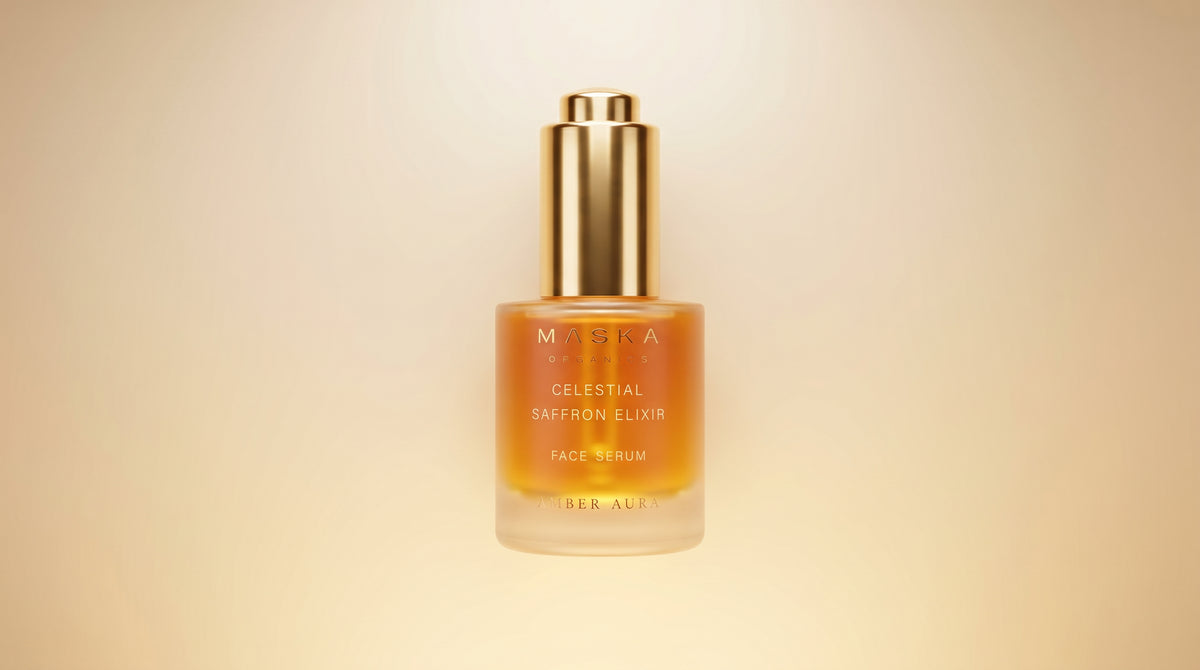
Why the Celestial Saffron Elixir Uses an Oil-Based Formula
Every formulation decision made during the development of Maska Organics' Celestial Saffron Elixir was a deliberate answer to a specific problem: how do you preserve and deliver one of the most bioactively complex - and fragile - ingredients in Ayurvedic skincare?
The Stability Challenge
Saffron's primary bioactive compounds - crocin, crocetin, and safranal - are sensitive to light, heat, oxygen, and water. In an aqueous (water-based) environment, these compounds degrade rapidly. A water-based saffron formula requires aggressive antioxidant stabilizers and preservative systems to remain functional - and even then, the window of potency is limited. Saffron's carotenoid compounds are understood to oxidize readily when exposed to the light, heat, and moisture that water-based formulas inherently involve, a stability concern reflected in Razavi and Hosseinzadeh's (2021) review of saffron's compound profile and protective properties.
An oil-based formula removes the primary destabilizing factor. Without free water, oxidation slows significantly. The bioactive compounds remain stable through a longer shelf life, and the formula delivers what the ingredient testing measured - not a degraded approximation of it.
The Delivery Alignment
Saffron's key compounds are lipid-soluble. Crocin and crocetin interact most effectively with the skin's outer protective layer - the same layer that an oil-based formula is structurally designed to reach. Delivering these compounds in a water-based formula is not merely less effective - it is misaligned with their chemical nature.
The Kumkumadi tradition understood this long before modern pharmaceutical science named it. Classical preparations combined saffron with specific oils and botanicals chosen to maximize the transfer and stability of saffron's active compounds. The Celestial Saffron Elixir applies that same logic in a modern, verified-potency format.
The Formulation Decision
During development, Maska Organics evaluated saffron from multiple sourcing regions before selecting a premium source for its color intensity, crocin-rich botanical profile, and sensory character. The oil base was selected not for fragrance or texture alone, but because it is the correct delivery environment for what saffron's chemistry actually requires.
The result is a serum that honors both the traditional intelligence of Ayurvedic oil-based preparation and the modern expectation of a high-performance, stable, daily-use formula - one in which every formulation decision was made in service of the ingredient, not the other way around.
Choosing an oil-based formulation wasn't simply a nod to tradition. It was a decision grounded in chemistry. Because saffron's most valuable compounds are naturally more compatible with oil than water, an oil-based serum provides an environment that helps preserve both their stability and their performance over time. In this case, modern formulation science reinforces what Ayurvedic practitioners recognized centuries ago.
"We didn't choose an oil base for the Celestial Saffron Elixir because oil-based formulas are fashionable. We chose it because saffron's bioactive compounds are lipid-soluble, degrade in water, and have been delivered in oil by Ayurvedic tradition for centuries. The science and the tradition agree."
— Mangai Varadachari, Founder, Maska Organics
Conclusion: Choosing the Right Serum Starts With Understanding Your Skin
Choosing the right serum isn't about deciding whether oil or water is better. It's about understanding how each formulation supports your skin in a different way. Once you understand that distinction, skincare becomes less about following trends-and more about making informed decisions your skin benefits from every day. Water-based serums are effective, versatile, and essential for delivering humectants and water-soluble actives. Oil-based serums are structurally compatible with the skin's own chemistry and indispensable for delivering lipid-soluble botanical actives that no aqueous system can carry effectively.
The most complete approach uses both - in the right order, chosen for the right reasons. A water-based serum applied first, followed by an oil-based serum, followed by a moisturizer, gives the skin both categories of active support in a layering sequence that respects how skin chemistry actually works.
Where Ayurveda contributes to this picture is in the reminder that oil is not a new idea in skincare. It is the oldest idea - chosen millennia ago for the same reasons modern formulation science now confirms: it is compatible, stable, and aligned with the biology of the skin it is meant to serve.
Observations noted are based on feedback shared by Maska consumers through individual use and end user results may vary. Expert evaluations and results will be shared as they become available.
Key Takeaways
- Water-based serums are designed to deliver water-soluble ingredients such as hyaluronic acid, niacinamide, and peptides.
- Oil-based serums deliver lipid-soluble botanical ingredients and complement the skin's natural protective functions.
- Neither formulation is universally better-they solve different skincare needs.
- Many routines benefit from layering a water-based serum first, followed by an oil-based serum.
- The best serum is the one that fits your skin's needs and can be used consistently.
Frequently Asked Questions
Can I use an oil-based serum if I have oily skin?
Yes, in many cases. Lightweight botanical oils such as jojoba or squalane are non-comedogenic and may actually help balance sebum production over time. The key is choosing a serum formulated with non-comedogenic oils and using it in appropriate amounts.
Should I apply oil-based or water-based serum first?
Water-based serums are always applied first. Oil creates a seal that limits penetration of subsequent water-soluble ingredients, so applying in the wrong order reduces the effectiveness of your water-based actives.
Is an oil-based serum the same as a face oil?
Not exactly. A face oil is typically a pure or blended oil without additional actives. An oil-based serum is a more concentrated formulation that uses an oil base to deliver specific botanical actives - antioxidants, brightening compounds, barrier-supportive lipids - with greater precision than a straight face oil.
Can I use both types of serums together?
Yes - using both in the correct layering order is often more effective than choosing one. Water-based serums target hydration and water-soluble actives; oil-based serums complement the skin's protective layer. Together they address both hydration and skin resilience in a single routine.
Are oil-based serums good for sensitive skin?
Often yes, particularly when formulated without synthetic fragrance or harsh actives. Botanical oil-based serums can be gentler than acid-forward water-based formulas, making them well-suited to easily irritated skin.
Scientific References
- Gehring W. (2004). Nicotinic acid/niacinamide and the skin. Journal of Cosmetic Dermatology, 3(2), 88–93. PubMed: PMID 17147561 — relevance to niacinamide, barrier function, and transepidermal water loss.
- Lin TK, Zhong L, Santiago JL. (2018). Anti-Inflammatory and Skin Barrier Repair Effects of Topical Application of Some Plant Oils. International Journal of Molecular Sciences, 19(1), 70. PubMed Central: PMC5796020 — relevance to botanical oils, linoleic acid, and barrier repair.
- Razavi BM, Hosseinzadeh H. (2021). Saffron as an antidote or a protective agent against natural or chemical toxicities: a review. Daru: Journal of Faculty of Pharmacy, Tehran University of Medical Sciences. PubMed: PMID 33356506 — relevance to saffron's compound profile and protective properties; general context for carotenoid stability discussed elsewhere in the formulation science literature.
- Papakonstantinou E, Roth M, Karakiulakis G. (2012). Hyaluronic acid: a key molecule in skin aging. Dermato-Endocrinology, 4(3), 253–258. PubMed: PMID 23467280 — relevance to hyaluronic acid, skin hydration, and aging.
- Verdier-Sévrain S, Bonté F. (2007). Skin hydration: a review on its molecular mechanisms. Journal of Cosmetic Dermatology, 6(2), 75–82. PubMed: PMID 17524122 — relevance to hydration mechanisms, transepidermal water loss, and barrier science.
This article draws on peer-reviewed research in dermatology, cosmetic science, and Ayurvedic formulation literature. All referenced studies are linked to their original sources. Claims about ingredient benefits reflect published research and are framed in accordance with cosmetic claim guidelines. Individual results from skincare products vary.
Last reviewed: July 2026