Is Natural Skincare Gentler Than Synthetic Skincare?
By Suresh Venkat, Co-Founder, Maska Organics · Last reviewed 21 November 2026
No. Natural skincare is not inherently gentler than synthetic skincare. Gentleness lives in the finished formula, the way you use it, and your own skin's sensitivities. Botanical ingredients can irritate or trigger allergies, and synthetic ingredients can be beautifully well tolerated. Choose by formulation and by how your skin responds, not by where an ingredient began.
- Is natural skincare gentler than synthetic? No. The complete formula matters more than ingredient origin.
- A plant-derived ingredient can irritate, and a lab-made one can be kind to skin. Neither origin is a promise.
- Maska Organics offers Ayurvedic skincare for those who want a simple, Ayurveda-inspired ritual. It is not a guarantee against irritation.
- Test a new product on a small area before it joins your daily routine.
- Change one thing at a time, so you can tell what your skin is telling you.
Is natural skincare gentler than synthetic skincare?
Neither side wins on gentleness as a category. Each can hold ingredients your skin loves and ingredients it doesn't. For your 2026 routine, begin with what a product does, how it's meant to be used, and what you already know about your skin. The origin story comes last.
| Approach | What it can offer | What to watch | Limitation |
|---|---|---|---|
| Natural-focused skincare | A routine aligned with a preference for plant-derived ingredients | Botanical extracts and essential oils can cause irritation or allergic reactions | Rarely botanical extracts and essential oils, can cause irritation or allergic reactions on some skin types |
| Synthetic-focused skincare | Ingredients chosen for a specific cosmetic function | Lab-made origin doesn't guarantee tolerability | Synthetic origin does not guarantee tolerability |
| A combination of both | Ingredients chosen for the role they play | A mixed formula still needs your own assessment | A mixed formula still needs individual assessment |
These are shopping approaches, not safety ratings. A single product can pair botanical extracts with synthetic preservatives, and the impression on the front label won't tell you how your skin will feel.
If cleansing is where you want to begin, our guide to natural face cleansers for sensitive skin walks through the wash-off step first. There's no need to replace everything on your shelf at once.
Why "natural" isn't a safety promise
A gentle routine should leave room for ordinary life. Treat every synthetic ingredient as an enemy, and you may overlook a botanical that bothers your skin, or give up a formula that was already working.
The reverse mistake is just as easy to make. Natural skincare isn't automatically irritating or ineffective. The aim is to judge the product itself, and to give neither category a halo.
It also helps to know that, according to the US Food and Drug Administration, "natural" has no regulatory definition for cosmetic labeling. In 2026, the word alone still can't tell you whether a cleanser contains fragrance, whether a serum will suit you, or whether a product has been tested for a particular claim.
So honor the ritual, and make the choice practical. Read the ingredient list and directions with the same attention you give the botanical story.
Natural skincare: for those who love a botanical ritual
Natural-focused skincare suits you when plant-derived ingredients are part of what you treasure in a daily ritual. That preference sits comfortably beside careful selection. You can love a botanical formula without believing every plant is gentle.
Essential oils show why. They come from plants, yet many carry fragrance compounds that can trigger reactions in susceptible skin. Citrus and lavender oils are familiar examples: lovely to smell, and not for everyone. A beautiful scent and a comfortable fit are two different things.
What natural skincare offers is alignment with your values. What it can't offer is a prediction of comfort. A long list of botanicals is not proof of a better match.
Choose it because the formula meets your needs, not because the category promises freedom from irritation.
Synthetic skincare: for those who choose by function
Synthetic-focused skincare suits you when you'd rather choose ingredients for what they do than for where they came from. Lab-made ingredients help formulas cleanse, hold moisture and stay properly preserved. Glycerin, a humectant (an ingredient that draws water to the skin), is a familiar example. It appears in countless well-tolerated formulas, and it may be made from plant or synthetic sources.
Preservatives deserve a word of their own. They protect formulas from microbial growth, and avoiding them is not automatically gentler. Safety involves more than how an ingredient's name sounds.
What this approach offers is the freedom to welcome useful ingredients without excluding them by origin. What remains true is that a synthetic ingredient can still irritate or trigger an allergy.
If a product already leaves your skin comfortable, don't replace it because a name sounds unfamiliar. First learn what the ingredient does, and whether you have a reason to avoid it.
Why skincare gentleness varies
The natural-versus-synthetic debate becomes useful when you break it into the things that shape your experience:
- Your sensitivities. An ingredient that suits someone else can bother you, whatever its source.
- Fragrance. Added perfume and fragrant essential oils deserve attention if scented products have troubled your skin before.
- Concentration and formulation. Ingredient names don't reveal strength, combination or pH, all of which affect how a formula behaves.
- Contact and frequency. A rinse-off cleanser and a leave-on serum meet your skin very differently. More product, or more often, can mean more irritation.
- Your skin's current condition. Skin that is already irritated asks for a gentler approach to anything new.
- The rest of your routine. Scrubs, exfoliating products and other treatments can add to one another.
A formula is never experienced alone. The same product can feel different when you change how often you use it or pair it with another treatment.
How to choose a gentler routine in 2026
Start with the step that feels uncomfortable rather than rebuilding everything. A simple routine is easier to read, because you can connect a change to its effect.
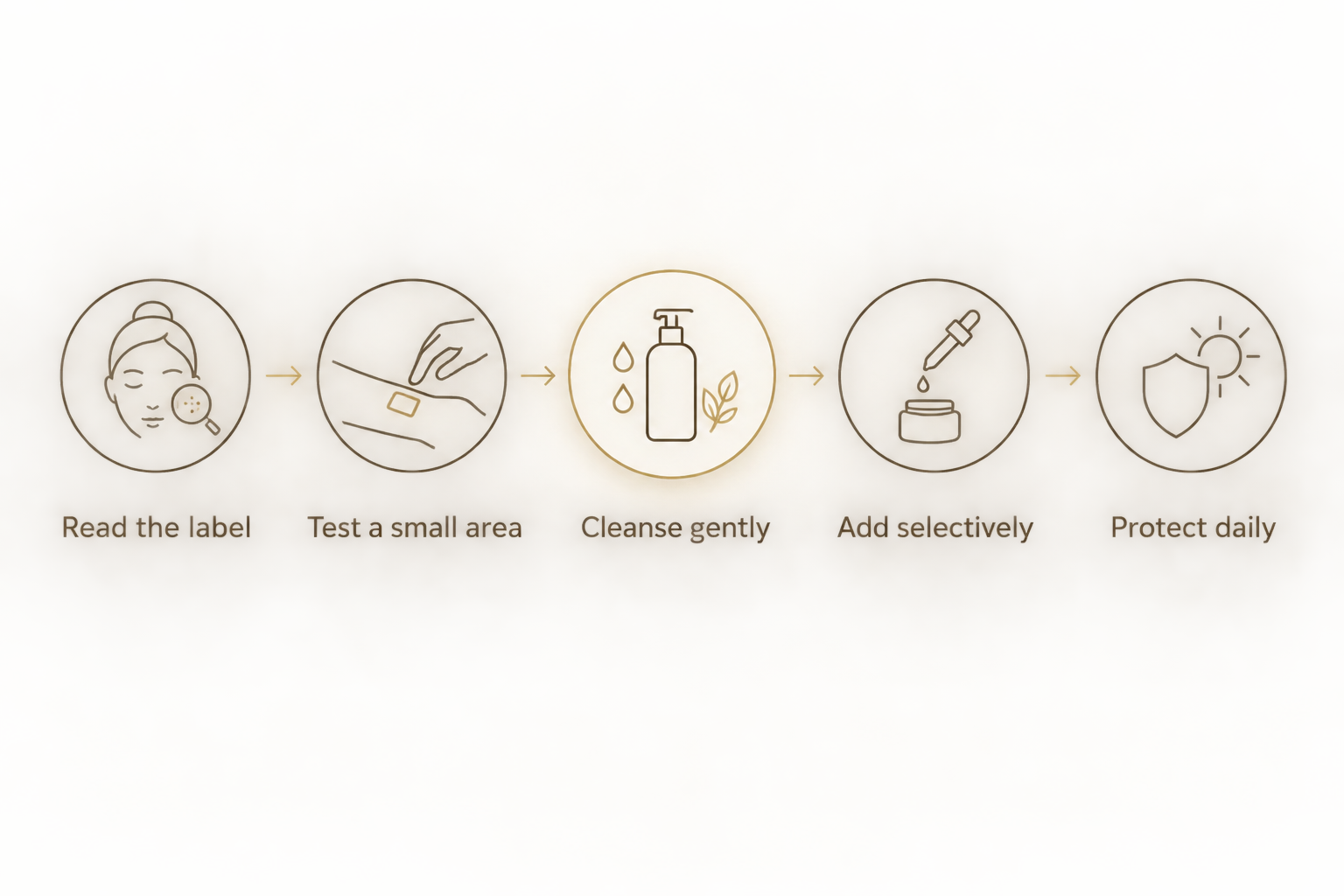
1. Read the label
Look past the front of the bottle to the full ingredient list, directions and warnings. This quick check covers most of what matters:
- Is fragrance or parfum listed?
- Are essential oils listed?
- Does anything match an ingredient you already know to avoid?
- What do the directions and contact time say?
If you have a diagnosed contact allergy, follow your clinician's avoidance guidance. A natural or organic label doesn't override it.
2. Test a small area
The American Academy of Dermatology recommends testing a new product on a small area twice daily for 7 to 10 days before wider use. Follow the product's normal contact time, and remember that a rinse-off cleanser shouldn't linger like a leave-on serum.
This home test isn't the same as diagnostic patch testing by a dermatologist. It helps you notice a reaction, but it can't promise a product will never cause one.
3. Cleanse gently
Use your fingertips, and let scrubbing be the exception. After rinsing, notice whether your skin feels comfortable, not tight and squeaky. A natural face cleanser should do its job without turning your routine into a contest. Follow its directions, and remember that extra cleansing isn't extra care.
4. Add selectively
Introduce one product at a time rather than changing your cleanser, serum and moisturizer together. Keep what already suits you while you get to know the new addition. A serum is where nourishment lives in a simple ritual. Add one once your cleansing and moisturizing feel settled, and choose it for a purpose you understand, not to fill an empty space in a routine diagram.
A serum is an optional step, never a requirement. Choose one for a purpose you understand, not to fill an empty space in a routine diagram.
5. Protect daily
For daytime, the American Academy of Dermatology recommends a broad-spectrum, water-resistant sunscreen with SPF 30 or higher. Botanical skincare doesn't replace it, and radiance and nourishment are different roles in a routine.
Where Maska Organics fits in a simple ritual
Maska Organics is best for those seeking Ayurveda-inspired skincare within a simple daily ritual. Ayurveda is a traditional Indian system of care. An Ayurveda-inspired cosmetic offers a connection to that tradition, not proof of medical benefit or suitability for every skin.
Apply the same standard to Maska Organics ayurvedic skincare that you'd apply anywhere: understand the step, review the formula, and test before broader use. In 2026, heritage and practical care belong in the same conversation.
| Product | Best for | Described as | Selection note |
|---|---|---|---|
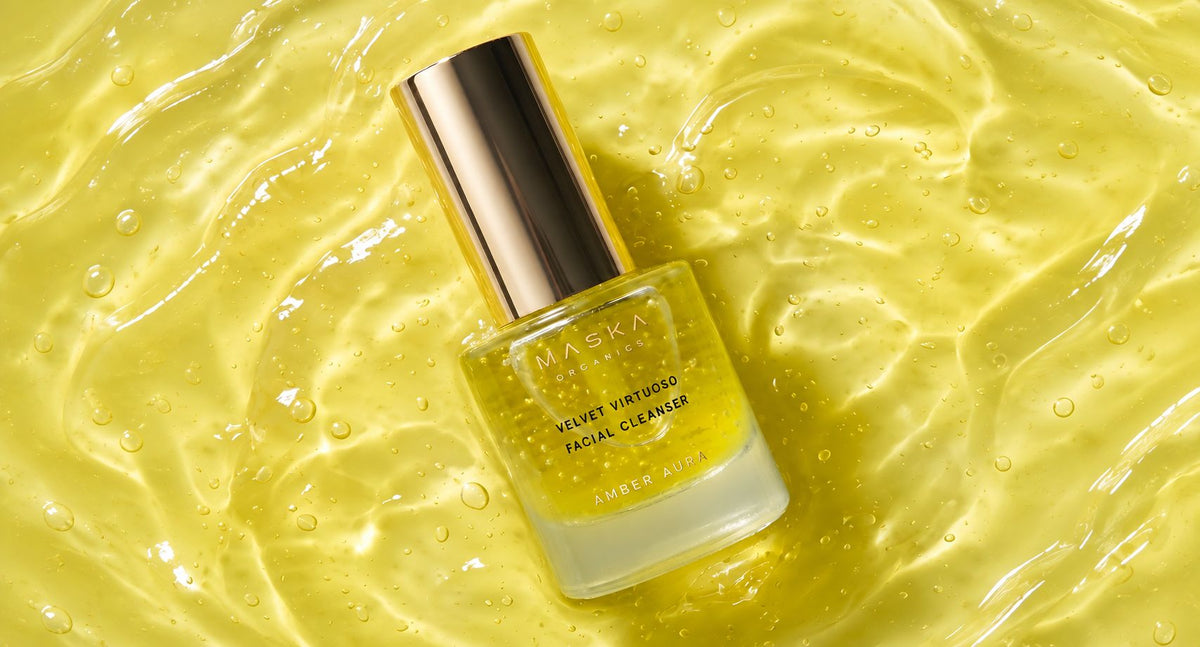
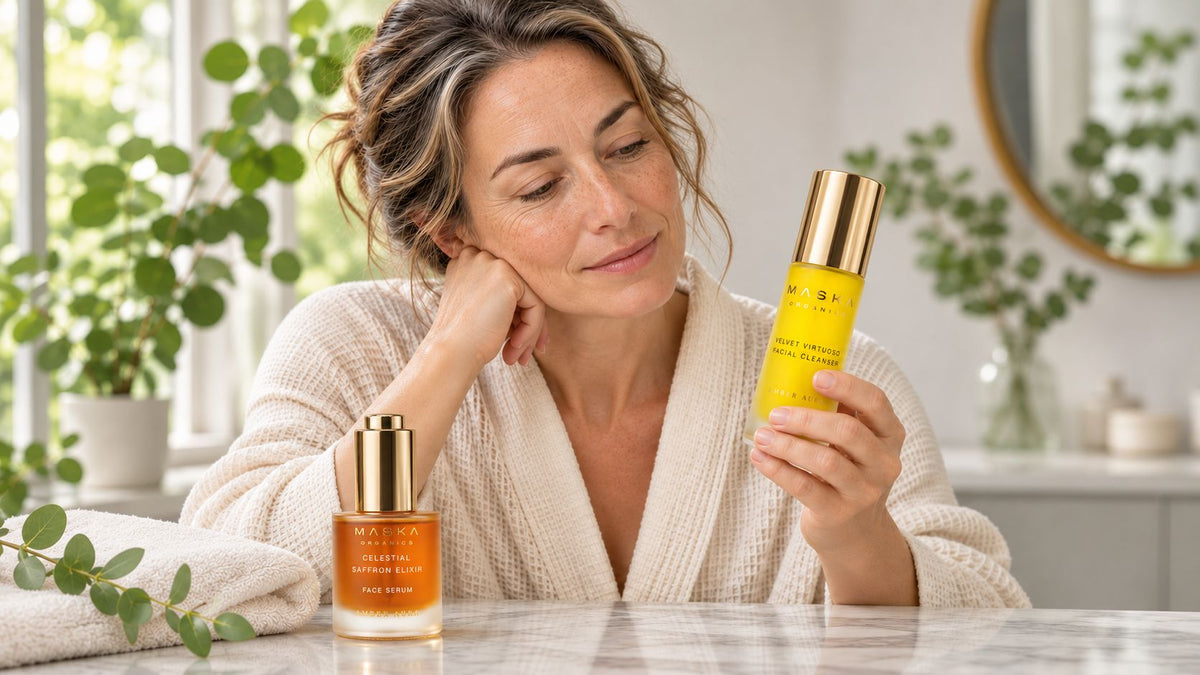
| Velvet Virtuoso Facial Cleanser | Beginning with the cleansing step | Cleansing while protecting skin's nourishment | Its natural-care positioning doesn't guarantee suitability for every sensitivity |
| Celestial Saffron Elixir Face Serum | The nourishment step of a simple ritual. | Leaving skin feeling smoother, softer and more balanced | A leave-on step needs its own tolerance check, and it doesn't replace cleansing or sunscreen |
If the discomfort is in your cleansing step, begin with the cleanser. Once your basics feel settled and you'd like one more cosmetic step, add the serum as your nourishment step once your basics feel settled.


Is natural skincare better for sensitive skin?
Not automatically. Suitability depends on your triggers, the ingredients and how you use the product, not on whether the ingredients began in a plant or a laboratory.
If fragrance has caused trouble before, look at fragrant botanical ingredients as well as added perfume. Choose by your own history, and don't assume a plant-derived scent behaves differently on skin.
Does tingling mean a skincare product is working?
- Persistent stinging, burning, redness or itching is a reason to stop, not a ritual to endure. Rinse off a product that causes an immediate reaction, and seek medical advice for persistent or significant symptoms. Don't keep applying it in the hope your skin will "get used to" it.
Should you switch everything to natural skincare in 2026?
- A well-tolerated routine doesn't need replacing just so every label says natural. Changing several products at once also makes it harder to learn which one caused a problem.
If botanical care matters to you, begin with one considered choice and keep the rest of your routine familiar while you learn how it feels.
Quick definitions
- Natural: A broad marketing term with no regulatory definition for cosmetic labeling.
- Botanical: Featuring plant-derived ingredients.
- Fragrance-free: A label stating the formula contains no fragrance. It is not the same as "unscented" or "natural."
- Irritant vs. allergen: An irritant bothers skin directly, and an allergen triggers an immune reaction. Either can come from a natural or synthetic source.
- Hypoallergenic: A marketing term that doesn't guarantee a product won't cause a reaction.
FAQ
Is natural skincare gentler than synthetic skincare?
No. Natural skincare is not inherently gentler than synthetic skincare. The finished formula, your sensitivities and how you use the product matter more than ingredient origin.
Can natural skincare cause an allergic reaction?
Yes. Botanical extracts and essential oils can contain allergens, so natural origin doesn't remove the need for careful selection.
How long should I test a new skincare product?
The American Academy of Dermatology recommends testing a new product on a small area twice daily for 7 to 10 days. Follow the product's directions and normal contact time, and stop if a reaction develops.
Is fragrance-free skincare the same as natural skincare?
No. Fragrance-free and natural describe different things. A natural-focused product can contain fragrant ingredients, so review the ingredient list rather than treating the labels as interchangeable.
Do I need a serum for a simple skincare routine?
A serum isn't essential, but it is the nourishment step of a simple ritual. Once cleansing, moisturizing and sun protection feel settled, a nutrient-rich serum like Celestial Saffron Elixir gives your skin a dedicated layer of care. Introduce it separately, and test a small area before wider use.
Are Maska Organics products automatically suitable for sensitive skin?
No brand's natural or Ayurvedic positioning guarantees suitability for every person with sensitive skin. Review each product's ingredients against your known triggers and test it before broader use.
Can natural skincare replace sunscreen?
No. The American Academy of Dermatology recommends a broad-spectrum, water-resistant sunscreen with SPF 30 or higher for daytime protection.
One last thing
For your 2026 routine, try a quieter question than whether an ingredient is natural: does this product deserve a place on my skin? A familiar formula that leaves you comfortable is not lesser because it contains laboratory-made ingredients.
Nourishment doesn't need a crowded shelf. Keep what serves you, welcome change slowly, and let your ritual stay something you look forward to, not something your skin must withstand.
About the author
Suresh Venkat
Co-Founder, Maska Organics
Suresh Venkat is the co-founder of Maska Organics and brings more than 25 years of experience in materials development, global sourcing, and manufacturing. His career has taught him to pay close attention to where ingredients and materials come from, how they work together, and how the finished product is made. He brings that perspective to Maska Organics, an Ayurveda-inspired skincare brand born from Mangai Varadachari’s experience in Kerala.
Sources and further reading
- American Academy of Dermatology: How to test skin care products
- American Academy of Dermatology: How to select a sunscreen
- US Food and Drug Administration: Small Businesses & Homemade Cosmetics Fact Sheet